
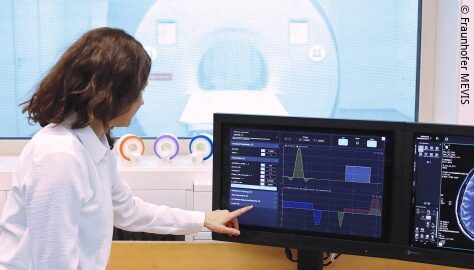
Magnetic resonance imaging (MRI) is one of the most important imaging techniques in modern medicine. The quality and informative value of the images depend largely on what are known as MR sequences. This control software determines how high-frequency pulses are transmitted, magnetic fields are switched, and signals are read during the examination.
Researchers at the Fraunhofer Institute for Digital Medicine MEVIS in Bremen are working on bringing new MR sequences into clinical use more quickly. The basis for this is the gammaSTAR software platform and the SpinIt project. The aim is to develop innovative imaging technologies independently of manufacturers and to facilitate their approval as medical devices.
"An MR sequence precisely defines how the various components must be controlled over time to create the desired image contrast," explains Dr. Daniel Hoinkiss, Principal Scientist at Fraunhofer MEVIS. "This fine control must operate with extremely high accuracy and is therefore very challenging to develop."
New MR sequences can help to significantly reduce examination times in MRI or enable new image contrasts for more precise diagnoses. "One focus of current developments is on sequences that accelerate the scanning process and reduce examination times from half an hour to just a few minutes," says Hoinkiss.
A key problem in transferring new MR sequences into clinical practice is the complexity of the approval processes. Sequences are often programmed directly in the device manufacturers' proprietary development environments and approved together with the respective hardware.
"For specialized or novel approaches, this barrier is often difficult to overcome," says project manager Hoinkiss. "Our aim is to simplify and, in a sense, democratize the certification process, making it more accessible for third-party providers."